
Street Food Around the World: 10 Dishes That Define Their Cities
From Bangkok's pad thai carts to Mexico City's taco stands, street food is the most authentic expression of a city's culinary identity. Explore ten iconic dishes and the stories behind them.
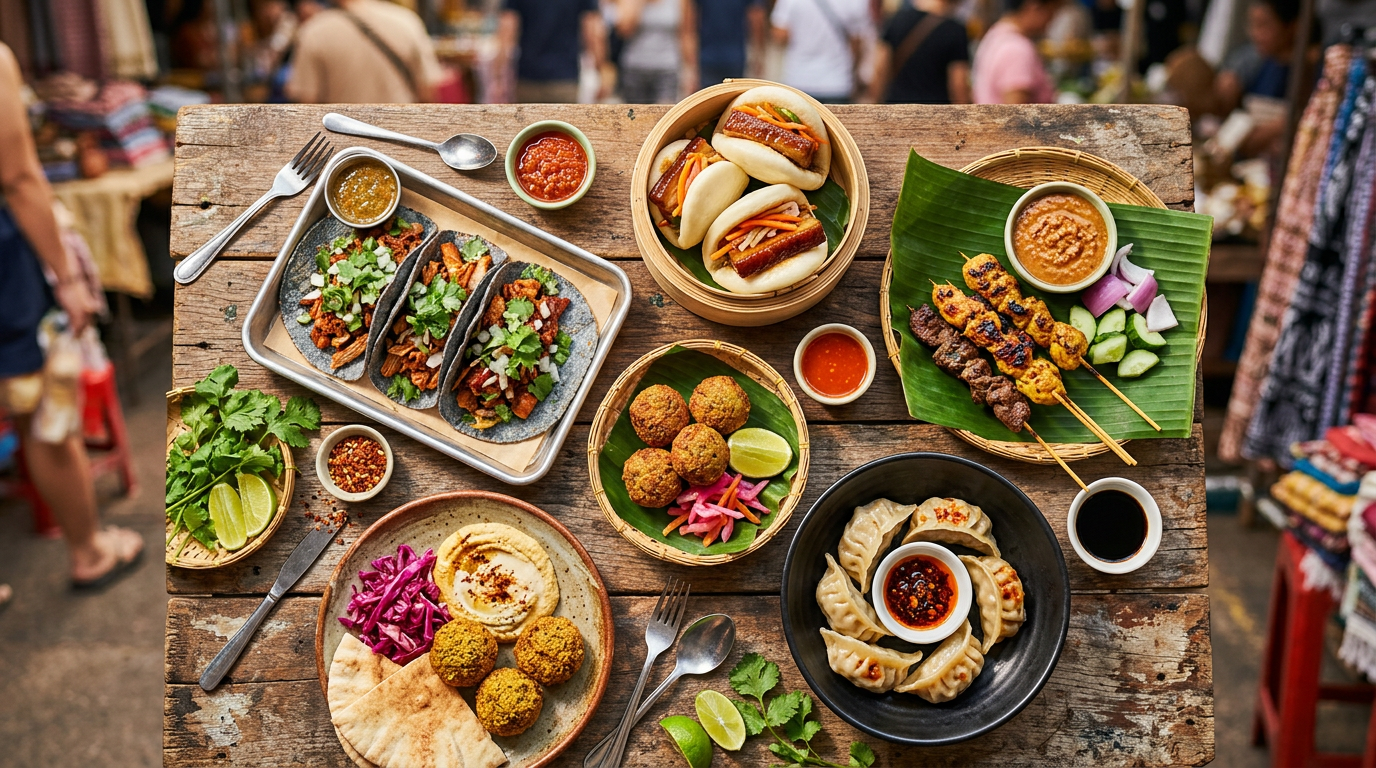
The soul of a city, served on a paper plate. Street food isn't just convenient — it's cultural DNA. The dishes sold from carts, stalls, and tiny storefronts carry centuries of tradition, migration, and innovation. They're shaped by local ingredients, historical events, and the daily rhythms of the people who make and eat them. Here are ten street food dishes that are inseparable from the cities that created them.
In Bangkok, Thailand, no dish embodies the city's street food culture more than pad thai from a wok cart. Cooked over a blazing charcoal fire in a seasoned carbon steel wok, the noodles pick up a smoky "wok hei" that's impossible to replicate at home. The balance of sweet tamarind, salty fish sauce, sour lime, and crunchy peanuts creates a flavor profile that's distinctly Thai. The best pad thai comes from vendors who've been making the same recipe for decades, their woks blackened with years of use.
In Mexico City, Mexico, tacos al pastor were inspired by Lebanese shawarma brought by immigrants in the early 20th century, and they are a perfect example of culinary fusion. Marinated pork is stacked on a vertical spit (trompo), slowly rotating as the outer layer crisps. The taquero slices thin shavings directly onto a warm corn tortilla, adding pineapple, onion, cilantro, and salsa. Every neighborhood in Mexico City has its favorite pastor stand, and the debate over which is best is endless and passionate.
In Istanbul, Turkey, the simit — a circular bread encrusted with sesame seeds — is the city's most iconic street food. Sold from bright red carts on nearly every corner, it's eaten at any time of day. The best simit has a crisp, glassy crust from a brief dip in molasses water before baking, with a soft, airy interior. It's often paired with Turkish tea from a small glass, and the combination is the city's unofficial breakfast.
In Osaka, Japan, takoyaki — ball-shaped snacks filled with diced octopus — originated in Osaka in 1935 and remain the city's signature street food. The batter is poured into special hemispherical molds, filled with octopus, tempura scraps, pickled ginger, and green onion, then flipped repeatedly until golden and round. Topped with takoyaki sauce, mayonnaise, bonito flakes, and seaweed powder, each bite is a burst of contrasting textures and flavors.
In New York City, USA, the dollar pizza slice is more than cheap food — it's an institution. A thin, foldable slice of cheese pizza, sold from countless corner pizzerias, represents the city's no-nonsense approach to food. The perfect slice has a crisp bottom, a chewy fold, and just enough cheese to hold it together. It's eaten on the go, often while walking, and it fuels the city's relentless energy.
In Mumbai, India, vada pav from a street stall — a spiced potato fritter in a soft bread roll with chutneys — is the city's answer to fast food. Created in the 1960s as affordable sustenance for mill workers, it's now beloved across all social classes. The vada (fritter) is made from mashed potatoes seasoned with mustard seeds, curry leaves, and green chilies, dipped in chickpea batter and deep-fried until golden. Served with spicy green chutney and sweet tamarind chutney, it's a masterclass in flavor layering.
In Marrakech, Morocco, vendors in the famous square of Jemaa el-Fnaa sell bowls of snail soup (babouche) from large copper pots. The snails are simmered for hours in a broth flavored with licorice root, thyme, and dozens of spices. The resulting soup is deeply aromatic and slightly medicinal — Moroccans believe it has healing properties. Eating snail soup at night in the square, surrounded by storytellers and musicians, is one of Marrakech's most authentic experiences.
In Singapore, Hainanese chicken rice from a hawker centre is the country's national dish, and the best versions come from hawker centres — open-air food courts that are the backbone of Singapore's food culture. The dish consists of poached chicken served over rice cooked in chicken fat and broth, accompanied by chili sauce, ginger paste, and dark soy sauce. The simplicity is deceptive. Perfect chicken rice requires precise temperature control, high-quality chicken, and rice that's been cooked to absorb maximum flavor.
In Buenos Aires, Argentina, choripán — chorizo sausage split and grilled, served in a crusty bread roll with chimichurri — is Argentina's most beloved street food. It's especially popular at football matches and asado (barbecue) gatherings. The chorizo is grilled over wood or charcoal until the casing is crisp and the interior is juicy. The chimichurri — a vibrant sauce of parsley, garlic, oregano, vinegar, and oil — cuts through the richness perfectly.
In Hanoi, Vietnam, bánh mì from a corner shop is a product of French colonial influence meeting Vietnamese ingenuity. A light, airy baguette (made with rice flour for extra crispness) is filled with pâté, various cold cuts, pickled daikon and carrot, fresh cilantro, and chili. The best bánh mì shops have been family-run for generations, and the balance of textures — crispy bread, soft pâté, crunchy vegetables, tender meat — makes each bite a perfect harmony.
What unites these ten dishes? They're all affordable, accessible, and deeply rooted in their local culture. They're made by people who've perfected their craft over years or decades. And they're eaten by everyone — from construction workers to CEOs — standing on the street, sitting on plastic stools, or walking through crowded markets. Street food is democracy on a plate. It doesn't care about your status or your budget. It only asks that you appreciate good food, made with skill and love, in the place where it was born.


