
Knife Skills 101: Essential Cuts Every Home Cook Should Know
Proper knife skills are the single most important technique in cooking. Learn the essential cuts that will make you faster, safer, and more consistent in the kitchen.
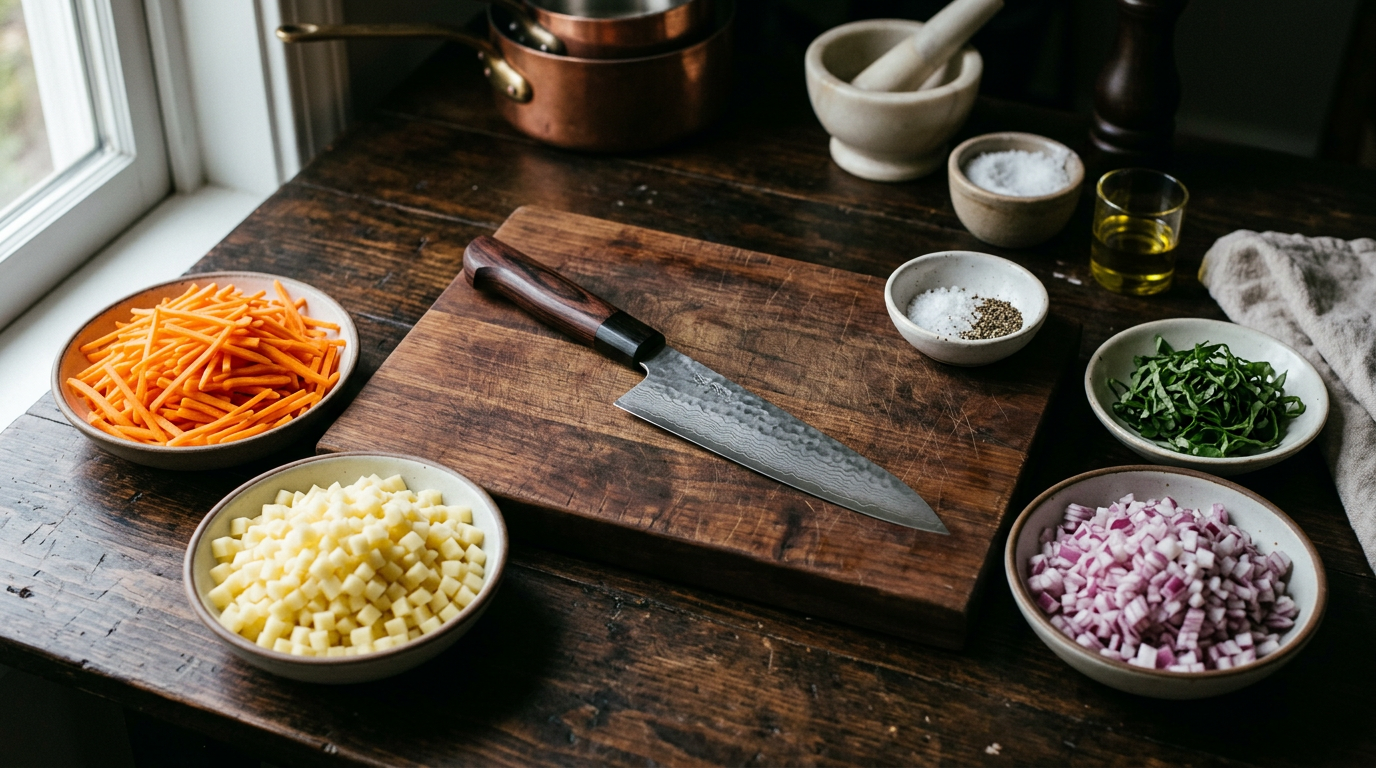
Watch any professional kitchen and you will notice something: before any cooking happens, there is prep work. And prep work is almost entirely about cutting vegetables and herbs into precise shapes. This is not about being fancy — it is about consistency, cooking evenly, and building the foundation of every dish.
Good knife skills make you faster, safer, and more confident. They transform cooking from a stressful scramble into a smooth, enjoyable process. And the good news is that you only need to learn a handful of cuts to handle 90% of home cooking.
Before we discuss technique, let us talk about your knife. You do not need an expensive set. You need one good chef's knife (8-inch / 20cm) and a honing steel. Keep it sharp — a sharp knife is safer than a dull one because it requires less force and is less likely to slip. The grip: pinch the blade between your thumb and index finger, just in front of the handle. Wrap your remaining fingers around the handle. This gives you maximum control. The claw: your non-knife hand should hold the food with fingers curled under, like a claw, with your knuckles guiding the blade. This keeps fingertips safely out of the way.
The smallest standard dice is the brunoise, a 1/8 inch dice. Start with a julienne, then rotate 90 degrees and cut into tiny cubes. It is used for fine garnishes, mirepoix for stocks, and delicate sauces. It is perfect for mirepoix, garnishes, fine salsas, and terrines.
The julienne, also called a matchstick cut, measures 1/8 x 1/8 x 2 inches. Slice the vegetable into thin planks, stack the planks, and cut into thin strips. The key is uniformity — every piece should be the same size. It is perfect for stir-fries, garnishes, spring rolls, and salads.
The batonnet measures 1/4 x 1/4 x 2.5 inches and is the larger version of julienne. Cut the vegetable into 1/4-inch thick planks, then into 1/4-inch wide sticks. This is the starting point for a small dice. It is perfect for crudités, french fries, and as a precursor to dicing.
For a small dice, a 1/4 inch cube, start with a batonnet, then cut into small cubes. This is one of the most commonly used cuts in home cooking. It is perfect for salsas, soups, stews, and sautés where you want small, uniform pieces.
A medium dice, a 1/2 inch cube, is a larger version of the small dice. Start with a 1/2-inch thick plank, cut into 1/2-inch strips, then into cubes. It is perfect for roasting vegetables, chunky salsas, and hearty soups.
A large dice, a 3/4 inch cube, is the largest standard dice. It is used when you want substantial pieces of vegetable that hold their shape during cooking. It is perfect for pot roasts, hearty stews, and rustic vegetable dishes.
Chiffonade is a cutting technique for leafy herbs and greens. Stack the leaves, roll them tightly into a cylinder, then slice thinly across the roll to create delicate ribbons. It is perfect for basil, mint, sage, and other leafy herbs used as garnish or flavoring.
Paysanne refers to thin, flat cuts that follow the natural shape of the vegetable. Carrots might be cut into thin rounds, zucchini into half-moons. The idea is to showcase the vegetable's natural form. It is perfect for soups, sautés, and dishes where a rustic appearance is desirable.
To practice, start with inexpensive vegetables. Buy a bag of potatoes, carrots, and onions, and spend 20 minutes practicing each cut. Focus on consistency over speed — speed comes naturally with practice. For the onion exercise, peel an onion and cut it in half through the root. Make horizontal cuts parallel to the board without cutting through the root. Then make vertical cuts. Finally, cut across to create a perfect small dice. Repeat until it feels natural.
For safety, always cut on a stable surface — use a damp towel under your cutting board. Keep your knife sharp — dull knives slip and cause accidents. Use the claw grip — your fingertips should never be exposed. Cut away from your body. If a knife falls, let it fall — never try to catch it. Carry your knife pointed down at your side, blade facing backward.
With practice, these cuts become second nature. You will find that recipes become easier to follow, cooking times become more predictable, and your dishes look more professional. More importantly, you will feel more confident and relaxed in the kitchen. That confidence is what separates cooks who enjoy the process from those who dread it.


