
A Complete Guide to Kitchen Equipment: Essential Tools for Home Cooks
Build your kitchen arsenal with this comprehensive guide to essential cooking equipment. From knives to pots, learn what you really need and what's worth the investment.
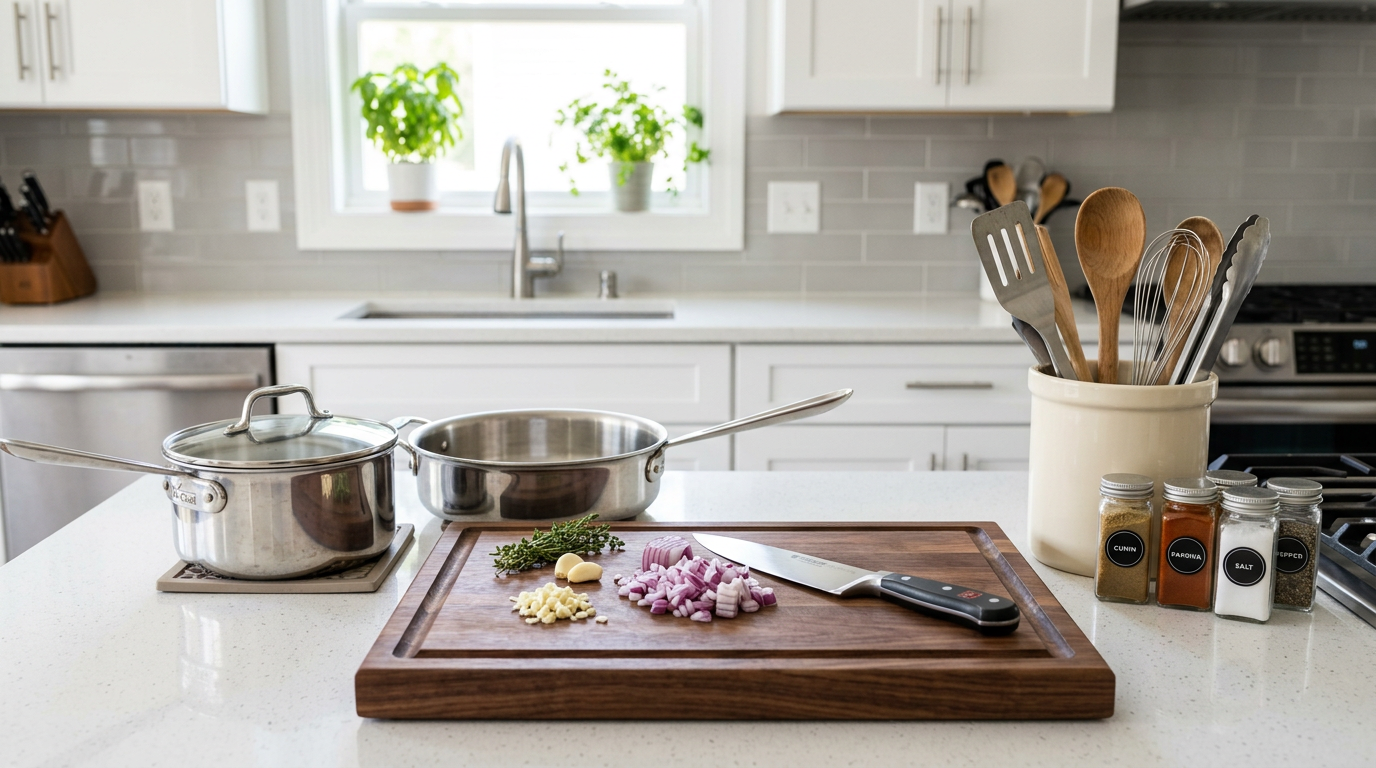
The Foundation of Great Cooking
A great kitchen is not defined by how many appliances it contains, but by whether the tools in it support the way you actually cook. Technique and ingredients are crucial, yet the right equipment makes cooking more efficient, enjoyable, and successful. You do not need a kitchen full of expensive gadgets. Instead, investing in a small number of quality essentials will serve you well for years. What follows is a practical guide to the equipment every home cook needs, with recommendations on what to prioritize and where to save money.
Knives are the most important tools in the kitchen. An 8-inch chef’s knife is the workhorse, used for chopping, slicing, dicing, and mincing. It is worth investing in the best you can afford, often between $100 and $200, and looking for a full tang, meaning the blade extends through the handle. A 3- to 4-inch paring knife handles small, precise tasks such as peeling, trimming, and detailed work. It is inexpensive but essential, and it should be kept sharp for safety. A serrated bread knife cuts bread without crushing it, and it is also useful for tomatoes and soft-skinned fruits. A long blade of 8 to 10 inches with a serrated edge works best, and this type of knife does not need frequent sharpening.
Proper knife care extends their life and keeps them safe. Store knives in a block, on a magnetic strip, or with blade guards. Never store them loose in a drawer, where blades can dull and become dangerous. Keep knives separated to prevent edge damage. Hone with a steel before each use to align the edge, sharpen with a whetstone every three to six months to remove metal, and consider professional sharpening once a year. Dull knives are more dangerous than sharp ones. Always hand wash knives, because dishwashers damage blades and handles, dry them immediately after washing, and never soak them in water.
Cutting boards protect both knife edges and countertops. Wood boards made from maple, walnut, or bamboo are gentle on knife edges, have natural antimicrobial properties, and require regular oiling, though they are heavy and stable. Plastic polyethylene boards are dishwasher safe, inexpensive, lightweight, and can be color-coded for different foods, but they show knife marks over time. Composite boards made from recycled materials are dishwasher safe, durable, and thin, making them a good choice for small kitchens. Use separate boards for raw meat and vegetables, replace boards when they become heavily grooved because grooves can harbor bacteria, secure a board with a damp towel underneath to prevent slipping, and oil wooden boards monthly with food-grade mineral oil.
Pots and pans form the core of a working kitchen. A 10- to 12-inch cast iron skillet is incredibly versatile and durable, with excellent heat retention and distribution, and it can go from stovetop to oven. It requires seasoning and care, but it can last generations with proper maintenance. A 3-quart stainless steel sauté pan is versatile for most cooking tasks, does not react with acidic foods, is oven-safe, easy to clean, and offers good heat distribution when it has an aluminum core. A 2-quart saucepan is useful for sauces, grains, and small batches, and it should have a heavy bottom for even heating and a tight-fitting lid. A 6- to 8-quart stockpot is made for soups, stocks, and pasta, with tall sides that prevent boiling over and a heavy bottom for even heating, making it essential for batch cooking. Non-stick pans are useful for eggs and delicate fish, but they do not last as long as other cookware, should not be used over high heat because it damages the coating, and should be replaced when the coating starts peeling. They remain a good budget option for specific tasks.
Baking equipment should be simple, sturdy, and reliable. Rimmed baking sheets in the half-sheet size of 13 by 18 inches are standard for cookies, roasted vegetables, and sheet pan dinners. It helps to have at least two for efficiency, and lining them with parchment paper makes cleanup easier. A 9 by 13 baking dish is used for casseroles, brownies, and cakes, and glass or ceramic versions work well because they can go from oven to table. A 12-cup muffin tin is useful for muffins, cupcakes, and portion control, with standard and mini sizes both helpful, a non-stick coating convenient, and silicone liners making release easier. A set of three mixing bowls in 1-quart, 3-quart, and 5-quart sizes is essential for prep and mixing. Stainless steel or glass bowls are good choices, and nested storage saves space.
Measuring tools may seem minor, but they determine consistency. Dry measuring cups usually come in a set of four with 1/4 cup, 1/3 cup, 1/2 cup, and 1 cup sizes. Stainless steel or plastic versions work, and dry ingredients should be leveled off with a straight edge. These cups should not be used for liquids. Liquid measuring cups are typically glass with a spout and markings, and 2-cup and 4-cup sizes are especially useful. Read them at eye level for accuracy, and make sure the markings are clear. Measuring spoons come in a set of four with 1/4 teaspoon, 1/2 teaspoon, 1 teaspoon, and 1 tablespoon sizes. Stainless steel is preferred, dual-sided metric and imperial markings are helpful, and keeping the set together on a ring prevents loss. A kitchen scale is essential for baking accuracy. A digital scale with a tare function that measures in grams and ounces is more accurate than volume measurements.
Utensils and tools should be chosen for comfort, durability, and safety. Wooden spoons do not scratch cookware, are heat resistant, and feel comfortable in the hand, so it is useful to have several in different sizes. Silicone spatulas are heat resistant up to 600 degrees Fahrenheit, flexible enough for scraping bowls, safe for non-stick surfaces, and essential for baking. Tongs should have a locking mechanism for storage, silicone tips to protect cookware, and a 12-inch length for safety, making them essential for grilling and sautéing. A balloon whisk is best for general use, a French whisk for sauces, and a flat whisk for roux, with stainless steel preferred. A slotted spoon and a spider are used for removing food from liquid, and a spider is better for deep frying. Long handles improve safety, and stainless steel is durable.
Some specialty tools are worth having because they solve specific problems well. A Microplane or zester handles citrus zest, garlic, ginger, and cheese. It is incredibly sharp and effective, transforms many dishes, and is inexpensive but invaluable. A peeler is most versatile in the Y-peeler style, with a sharp blade for efficiency and a comfortable grip. Replace it when it becomes dull. A can opener can be manual for reliability or electric for convenience, but it is wise to keep a backup and replace it when the cutting wheel dulls. A thermometer is essential for food safety, whether it is an instant-read model for meat and candy, an oven thermometer for accuracy, or a fridge and freezer thermometer for safe storage temperatures.
Storage and organization keep a kitchen functional. Glass containers do not stain or retain odors, are microwave and dishwasher safe, allow you to see the contents easily, and come in various sizes. Plastic containers are lightweight and unbreakable, good for lunches and leftovers, available in BPA-free options, and should be replaced when stained or warped. Mason jars are versatile for storage and preserving, have an airtight seal, can go from freezer to microwave, and come in various sizes. Drawer dividers keep utensils organized, maximize drawer space, adjust for different sizes, and are easy to clean. Pot racks free up cabinet space, keep frequently used pots accessible, and can be both decorative and functional. A spice rack keeps spices visible and accessible, comes in drawer, door, and countertop styles, and works best when spices are labeled clearly with dates and rotated regularly.
When building a kitchen on a budget, some items deserve investment while others do not. Invest in a chef’s knife at $100 to $200 for quality that lasts, a cast iron skillet at $30 to $50 for lifetime use, a cutting board at $30 to $50 for durable wood, and stainless steel pots at $100 to $200 for a set. Save on measuring tools, which can be inexpensive but accurate, utensils, where basic versions work fine, mixing bowls, where simple stainless steel is enough, and baking sheets, where standard aluminum performs well. Skip unitaskers, or single-purpose gadgets, expensive knife sets because buying individual knives is better, copper cookware because it is high maintenance, and specialty appliances unless they will be used regularly.
Building a well-equipped kitchen is a gradual process. Start with the essentials and add tools as your cooking skills and interests develop. Quality matters more than quantity, and a few well-chosen tools will serve you better than a drawer full of gadgets you never use. The best equipment is the equipment you will actually use, so choose tools that fit your cooking style, space constraints, and budget. With these fundamentals in place, you will be well-equipped to tackle any recipe that comes your way.


