
The Complete Guide to Meal Prep: Save Time and Eat Better
Master the art of meal preparation to save time, reduce stress, and eat healthier throughout the week. Learn strategies, recipes, and storage techniques.
The Power of Meal Prep
Meal preparation is one of the most effective strategies for eating better, saving money, and reducing daily stress. By dedicating a few hours each week to preparing meals in advance, you can transform your relationship with food and reclaim valuable time during busy weekdays. Whether you are a busy professional, a parent juggling multiple responsibilities, or simply someone who wants to eat healthier without the daily cooking burden, meal prep offers solutions that fit your lifestyle.
The advantages of meal prep are practical and wide-ranging. It can reduce daily cooking time from around forty-five minutes to ten minutes, remove the recurring question of what is for dinner, make grocery shopping more focused, and turn batch cooking into a more efficient habit than cooking every day. Health improves because you control ingredients and portion sizes, rely less on takeout and processed foods, ensure more balanced nutrition throughout the week, and avoid impulsive choices when hunger strikes. Financial benefits come from reducing food waste through planned use, buying ingredients in bulk for better prices, spending less on takeout and delivery, and making the most of seasonal, affordable produce. Stress also declines when daily meal planning pressure disappears, cleanup is reduced because you cook once and eat multiple times, backup meals are ready for unexpected situations, and predictable routines replace decision fatigue.
There are several ways to approach meal prep. Batch cooking means preparing large quantities of complete meals and portioning them out for the week. It works especially well for soups, stews, casseroles, baked dishes, grain bowls, salads, and pasta. Its strengths are maximum time efficiency, complete meals that are ready to go, and easy portioning and storage, while its limitations can include repetition, dishes that do not reheat well, and a significant upfront time commitment. Ingredient prep focuses on preparing individual components that can be mixed and matched throughout the week. This suits busy schedules with varying preferences, families with different tastes, people who want variety, and those who enjoy assembling meals. It offers flexibility, variety, longer-lasting freshness, and the ability to accommodate different dietary needs, though it still requires daily assembly time, more containers, and planning for combinations. Make-ahead meals involve preparing complete meals that can be frozen and reheated as needed. This is useful for long-term planning, emergency backup meals, freezer-friendly dishes, and busy weeks with unpredictable schedules. Meals can last for months and offer ultimate convenience, but they require freezer space, some textures change after freezing, and they are less fresh than weekly prep.
Essential equipment makes the process smoother. Glass storage containers do not stain or retain odors, are microwave and dishwasher safe, allow you to see the contents easily, and come in various sizes such as one-cup, two-cup, and four-cup capacities. BPA-free plastic containers are lightweight, unbreakable, good for lunches and transport, and stackable for efficient storage, though they should be replaced when stained or warped. Mason jars are perfect for salads and overnight oats, provide an airtight seal, allow effective layering, and are portable and leak-proof. For cooking, two or three large sheet pans are useful for roasting vegetables and proteins; a standard half-sheet size is thirteen by eighteen inches, and lining them with parchment makes cleanup easier. A large pot and Dutch oven, ideally six to eight quarts, are good for soups, stews, and grains, with a heavy bottom for even heating and oven-safe construction for versatile cooking. A slow cooker or Instant Pot offers set-and-forget cooking, handles tough cuts of meat well, cooks while you do other tasks, and improves meal prep efficiency. Prep tools matter too. A sharp chef’s knife is essential for efficient chopping, saves time, reduces frustration, and should be kept sharp for safety and speed, with an eight-inch blade being the most versatile. Two or three cutting boards allow separate boards for different foods, large boards improve efficiency, color-coding supports food safety, and stable non-slip boards are safest. A food scale provides accurate portion control, is essential for tracking nutrition, is more precise than volume measurements, and works best when digital with a tare function.
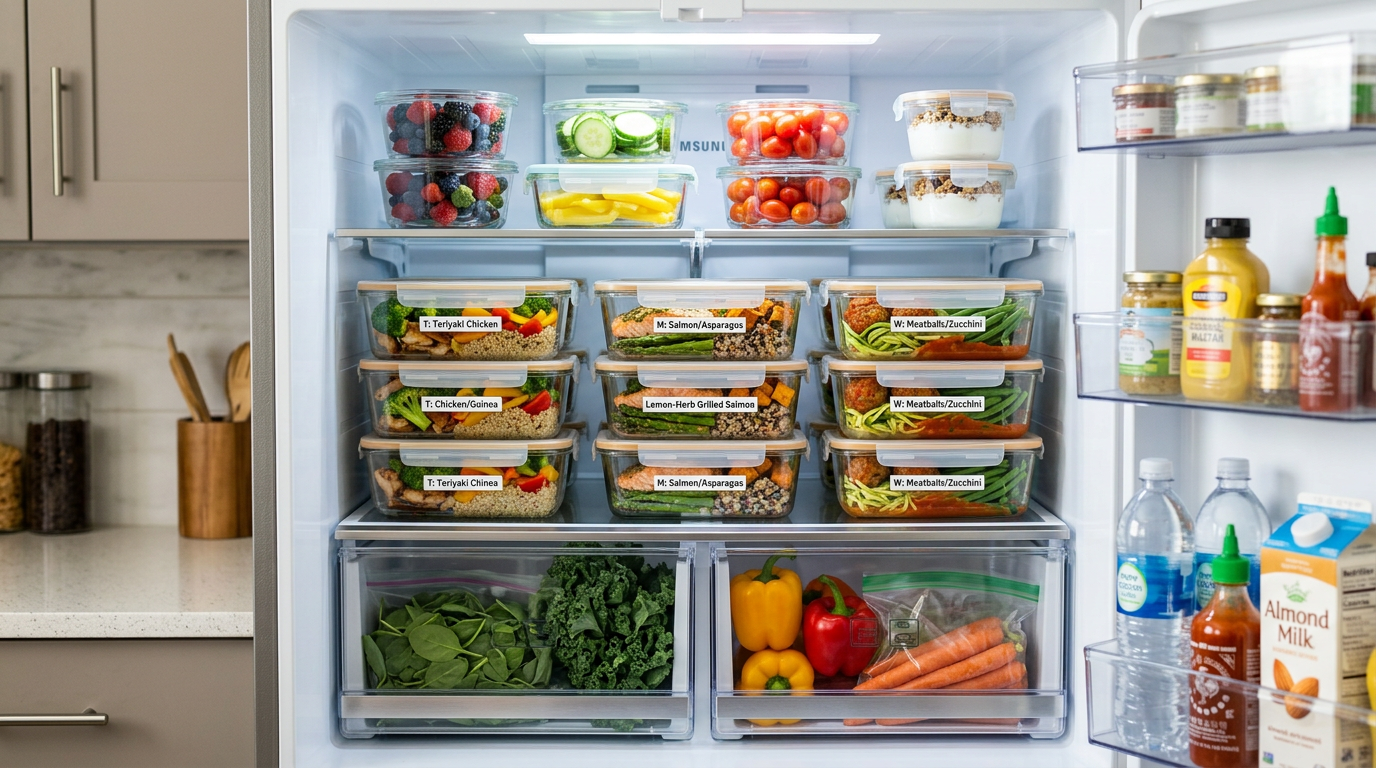
A practical weekly workflow begins with planning meals for fifteen to thirty minutes. Consider the schedule for the week, since busy nights need quick meals, along with dietary needs and preferences, ingredients that can be used across multiple meals, and a balance of proteins, vegetables, and grains. Create a menu with five to seven dinners, three to four lunch options, breakfast ideas, and snacks or sides. Then make a grocery list in about ten minutes, organized by store sections such as produce, proteins, grains and pasta, dairy and eggs, and pantry staples. Check your pantry first to avoid buying duplicates, use what you already have, and note what needs replenishing. Grocery shopping may take one to two hours; shop with a full stomach to avoid impulse buys, follow your list strictly, buy frequently used items in bulk, and choose seasonal produce for better prices. Prep day usually takes two to four hours, and Sunday afternoon or evening often works well, especially after grocery shopping when ingredients are fresh and when you have uninterrupted time. Music or podcasts can make the process more enjoyable. Begin by washing and chopping all vegetables, then cook grains and legumes, prepare proteins, make sauces and dressings, and finally assemble and store meals. Label everything with the date of preparation, contents, reheating instructions, and use-by dates for food safety. Organize meals by day so Monday meals are together and Tuesday meals are together, making grab-and-go access easier. Store refrigerator meals for three to four days, use the freezer for longer storage, cool food completely before refrigerating, and use airtight containers.
Recipes can be adapted across categories. For proteins, grilled chicken breast can be seasoned with salt, pepper, and herbs, then grilled or baked at four hundred degrees Fahrenheit for twenty to twenty-five minutes; it can be sliced or kept whole for versatility and stores for four days refrigerated. Baked salmon can be seasoned with lemon, dill, and olive oil, baked at three hundred seventy-five degrees Fahrenheit for twelve to fifteen minutes, flakes easily for salads and bowls, and stores for three days refrigerated. Hard-boiled eggs boil for ten to twelve minutes, benefit from an ice bath for easy peeling, work well for snacks and salads, and store for one week refrigerated. Cooked lentils simmer for twenty to twenty-five minutes, are versatile for soups, salads, and bowls, are high in protein and fiber, and store for five days refrigerated. For grains, quinoa should be rinsed before cooking, uses one part quinoa to two parts water, simmers for fifteen minutes, and becomes fluffy and protein-rich. Brown rice uses one part rice to two and a half parts water, simmers for forty to forty-five minutes, has a nutty flavor and chewy texture, and stores well for reheating. Roasted sweet potatoes can be cubed and tossed with olive oil, roasted at four hundred degrees Fahrenheit for twenty-five to thirty minutes, become sweet and caramelized, and work well in bowls and sides. For vegetables, roasted mixed vegetables such as broccoli, bell peppers, zucchini, and carrots can be tossed with olive oil, salt, and pepper, roasted at four hundred twenty-five degrees Fahrenheit for twenty to twenty-five minutes, and used in almost any meal. Steamed broccoli should steam for four to five minutes until bright green, then receive an ice bath to stop cooking, resulting in a crisp-tender texture that stores for four days. Sautéed greens such as spinach, kale, or Swiss chard can be cooked with garlic and olive oil, are quick and nutritious, and store for three days. For sauces and dressings, a basic vinaigrette uses three parts oil to one part acid, with mustard, salt, and pepper added, and can be whisked or shaken in a jar and stored for one week. Tahini sauce combines tahini, lemon juice, garlic, and water, can be thinned to the desired consistency, works well for bowls and salads, and stores for one week. Pesto combines basil, pine nuts, garlic, parmesan, and olive oil, blends until smooth, can be frozen in ice cube trays for portions, and stores for one week refrigerated.
Food safety should guide every step. The danger zone is forty to one hundred forty degrees Fahrenheit, where bacteria grow rapidly. Refrigerate promptly within two hours of cooking, cool quickly by dividing large batches into smaller containers, and reheat thoroughly to an internal temperature of one hundred sixty-five degrees Fahrenheit. Cooked meat keeps for three to four days refrigerated, cooked grains for four to five days, cut vegetables for three to four days, cooked beans for four to five days, and soups and stews for three to four days. When freezing, label with the date to track storage time, leave headspace because liquids expand when frozen, cool completely before freezing, and use within three months for best quality.
Common problems are easy to address. If food gets soggy, store wet and dry ingredients separately, add dressings just before eating, use crisper vegetables that hold up well, and reheat properly to restore texture. If meals get boring, prep components rather than complete meals, keep a variety of sauces and seasonings, mix and match different combinations, and freeze some meals for later variety. If there is not enough time, start with just two or three meals per week, use shortcuts such as pre-cut vegetables and canned beans, enlist family members to help, and focus on simple one-pan meals. If food waste is a concern, plan meals that use similar ingredients, start with smaller batches, freeze extras before they spoil, and compost unavoidable waste.
Meal prep is a skill that improves with practice. Start small, find what works for your lifestyle, and gradually build your routine. The initial time investment pays dividends throughout the week in saved time, reduced stress, and better eating habits. Remember that meal prep does not have to be perfect or elaborate. Even preparing a few components or one batch-cooked meal can make a significant difference. Find your rhythm, experiment with different strategies, and enjoy the freedom that comes with having healthy, delicious meals ready to go.


